

I have seen it happen in boardrooms more times than I can count. A product is ready. The engineering team has worked flat out for months. Marketing has the campaign locked and loaded and the Sales team are pumped and primed. The date is in the calendar. And then the launch arrives – and nothing much happens.
Not because the product was wrong. Not because the team didn’t deliver. Because the leadership confused a launch plan with a go-to-market strategy. And they are not the same thing.
The Calendar Trap
Let’s be honest. Most organizations treat a product launch as a project management exercise. Set the date. Build the plan. Coordinate the teams. Ship.
And that’s exactly the problem.
A launch plan is date-driven. It answers one question – when and how do we ship? Done well, it is a genuinely powerful coordination tool. Done in isolation, it is a date on a calendar dressed up as a strategy.
But a go-to-market (GTM) strategy is conditions-driven. It answers a different question entirely. For GTM to work, leaders need to know what is true in the market – about customers, competition, positioning, and readiness. It is not a timeline. It is a set of truths you have established before the date means anything at all.
The question, of course, is: how many leaders have actually established those truths before the launch?
What Conditions Are We Actually Talking About?
McKinsey shows that most leaders do not take the necessary actions to drive growth. And that means aligning leadership behaviors with five critical mindsets:
- Prioritizing growth
- Acting boldly
- Maintaining a customer centric approach
- Attracting and nurturing talent
- Executing with rigor.
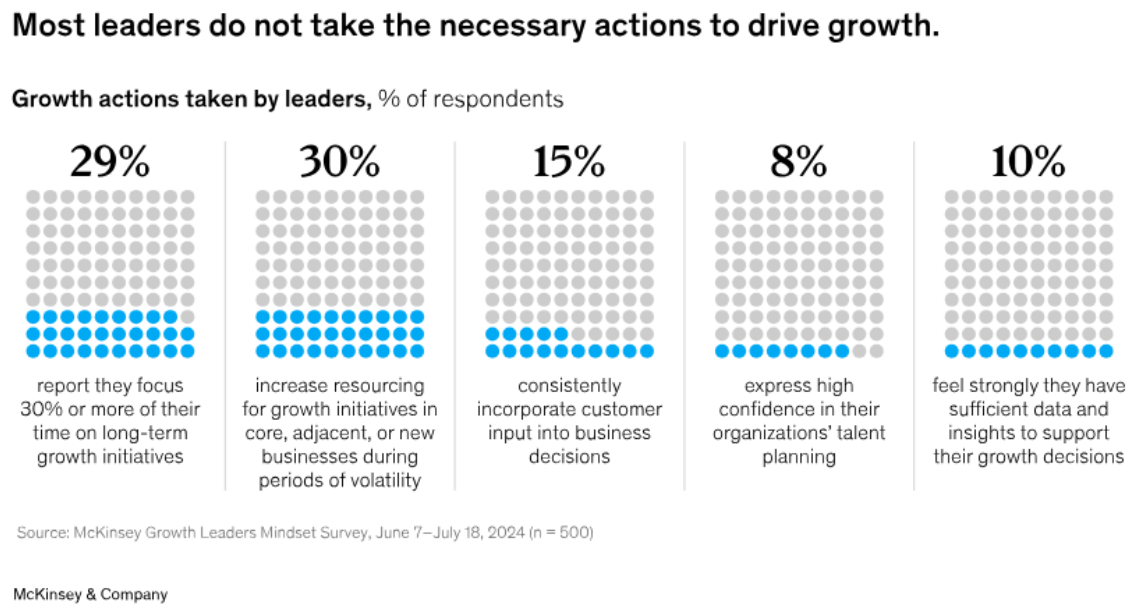
So what’s going wrong?
A staggering 98% of leaders say their strategy is in motion, but only 10% say it’s delivering at the level they need.
The conditions that a GTM strategy must establish are not complicated. But they are uncomfortable to surface early, which is why so many teams skip them. As leaders, we need to ask:
- Is the problem we are solving urgent enough that a customer will actually change their behavior to adopt the solution?
- Is our positioning differentiated where it matters – not just where it feels safe?
- What does our competitor’s customer currently believe, and how does our go-to-market account for that?
- What does “ready” actually mean for your sales team – not in training hours, but in their genuine confidence to have the conversation?
These are not launch questions. They are strategy questions. And the moment you treat them as launch questions – something to resolve in the week before go-live – is the moment your launch becomes an expensive event rather than a market entry.
The Alignment Problem That Nobody Wants to Name
As Highspot’s research on GTM failure makes clear, the most common breakdown is not in execution. It is in alignment. Teams across sales, marketing, product, and finance do not share a consistent understanding of what the market actually requires. Assumptions vary. Priorities differ. And by the time launch day arrives, everyone is executing – confidently – in slightly different directions.
I have watched this play out. Sales believes the product solves a cost problem. Marketing has positioned it as a growth solution. Product built it around an efficiency use case. And the customer, caught in the middle, isn’t sure what they are being sold.
SiriusDecisions research shows that companies with tightly aligned sales and marketing teams achieve 19% faster growth and 15% higher profitability. That is the compounding return on getting the conditions right.
Simon Sinek captured something important in his landmark TED Talk, How Great Leaders Inspire Action: great leaders start with why. The conditions your GTM strategy needs to establish are, at their core, answers to why – why this customer, why now, why us, why will this work. The launch plan answers the how. Strategy answers the why.
The Mindset Shift That Changes Everything
Many leaders — and I include myself in earlier parts of my career — rise through execution excellence. The ability to deliver, to coordinate, to hit milestones. That is a genuine and valuable capability.
And there is a moment in every leader’s growth where that capability is no longer the whole answer. GTM strategy demands a shift up the strategic register. From managing outputs to establishing conditions. From “are we on track?” to “have we earned the right to succeed in this market?”
As I explored in The Leadership Mindset — Reset to Thrive, this kind of reset is not a one-time intervention. It is a practice. The good news is that much of this can be learned. It starts with asking better questions – earlier, and together.
Nina Nets It Out
A launch plan gets your product out the door. A GTM strategy earns it a place in the market. Let us remember that the leaders who win consistently are not always the fastest or the best resourced – they are the ones who stopped asking “are we ready to ship?” and started asking “have we established everything that needs to be true for this to succeed?” One question manages a calendar. The other builds a business.